How to Reprogram Your Subconscious Mind (to Stop Self-Sabotage)

Your subconscious runs the beliefs, habits and reactions you never chose deliberately, including the ones that make you self-sabotage. It learned them early, through repetition and emotionally charged events, and it treats them as facts. Reprogramming it means replacing a belief that no longer fits with one that does, using the same channels it learned through in the first place: repetition, emotion, and a relaxed, focused state.
Below: what the subconscious actually is, the four methods that change it, which one to use for what, and how long it takes.
What the subconscious is, and is not
It is not mystical. It is the set of automatic processes running below conscious awareness: pattern recognition, emotional response, habit execution. It is faster and older than deliberate thought, which is why "just decide to change" fails: the decision is conscious, the pattern is not. It responds to input that is repeated, emotionally vivid, and delivered while your critical, analytical mind is quiet: on waking, before sleep, or in a focused, relaxed state.
The four methods
| Method | How it works | Best for |
|---|---|---|
| Affirmations | Repetition of a chosen belief, ideally on waking or before sleep when the critical mind is soft | Reinforcing a change already underway, especially for low-resistance beliefs |
| Visualization | Practising an outcome in vivid detail so the brain codes it as lived experience | Performance, and specific feared moments like a launch or a hard conversation |
| Meditation | Quieting the conscious mind and noticing the automatic thoughts | Spotting the beliefs in the first place, and making the other methods land deeper |
| Self-hypnosis | Guided relaxation into a focused state, then direct suggestion to the subconscious | Deep or defended beliefs, the fastest route for entrenched self-sabotage |
Why self-hypnosis is the direct route
Affirmations and visualization work, but slowly, because the critical mind argues back: "no I am not." In practice you can watch someone do this out loud: they say the new line and their face does the rejection before the sentence is finished. Self-hypnosis lowers that resistance first, through the relaxed, absorbed state, then delivers the new belief while the gate is open. That is why one focused session can shift something years of positive thinking could not. For self-sabotage, the belief being replaced is almost always a version of "success, visibility or wanting is not safe," and it is well defended, which is exactly what hypnosis is built for.
How to start
- Pick one belief. Say the old rule in a sentence: "if I succeed too visibly, I will be punished or left or resented." Write the replacement: "I am safe to be seen and to succeed."
- Choose your state. Ten minutes, no interruptions, eyes closed, slow breathing, or use a guided self-hypnosis audio that does the induction for you.
- Deliver it with emotion and detail. Do not repeat the words on autopilot. Picture the situation and let the safe feeling be real. Flat repetition does very little.
- Repeat daily for two to three weeks. The subconscious changes by repetition, not by insight.
FAQ
Can you actually reprogram your subconscious mind?
You can change specific learned beliefs and automatic responses. That is well established, and it is how habits, phobia treatment and performance psychology all work. What you cannot do is wipe it and start over, or change everything at once. Realistic reprogramming is one belief at a time, using repetition, emotion and a relaxed state.
How long does it take?
For a single, well-chosen belief with daily practice, most people notice a shift in two to three weeks, with it becoming the new default over roughly two months. Defended beliefs tied to self-sabotage can move faster with self-hypnosis because it bypasses the conscious pushback, but "faster" still means consistent daily reps, not one session and done.
When is the best time to do it?
When your critical mind is least active: the first few minutes after waking, the last few minutes before sleep, and during any deliberate relaxed, focused state. Input at those times meets less resistance. The same affirmation read at 3pm in a busy office does far less.
Do affirmations actually work?
They work when the belief is close to believable and there is little internal resistance, then repetition tips it over. They do the least when the gap is wide ("I am wealthy" while broke) or the belief is defended, because the critical mind rejects each rep. For those cases, lower the resistance first (relaxation, self-hypnosis) or make the affirmation small enough to be plausible.
Where this fits
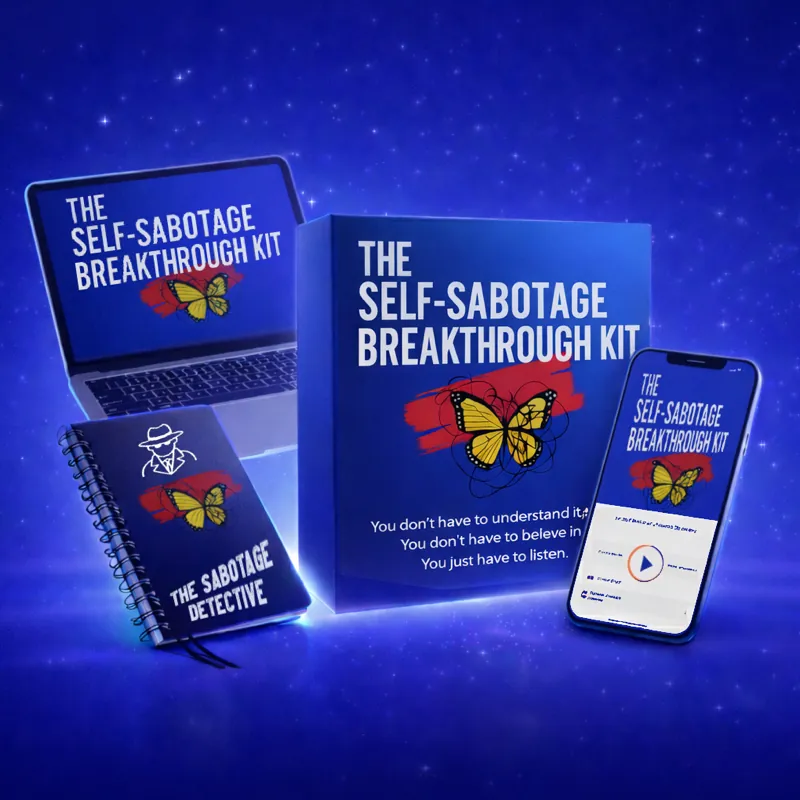
This is step four of the full method for stopping self-sabotage. If you would rather have it done for you, the Self-Sabotage Breakthrough Kit targets the common patterns, and 1:1 hypnotherapy works your specific belief directly. New to the pattern? Start with why you self-sabotage.